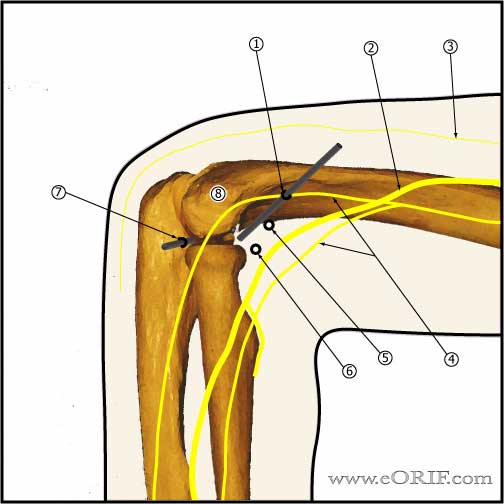
Superomedial portal (proximal anteromedial portal): anterior to the intermuscular septum, 2cm proximal to the medial epicondyle. Must stay anterior to the medial intermuscular septum to aboid ulnar nere injury.
Anteromedial portal: generally used to augment superomedial portal. Ensure ulnar nerve is not subluxed before establishing anteromedial portal. Generally 2cm distal and 2 cm anterior to the medial epicondyle. Risks: ulnar nerve, medial antebrachiocutaneous nerve.
Standard Lateral Portals
Proximal anterolateral portal: 2cm proximal and 1cm anterior to the lateral epicondyle. Lowest risk or radial nerve injury. (MIller C, JSES 1995;4:168).
Radial Nerve
Posterior antebrachial cutaneous nerve
Lateral antebrachial cutaneous nerve
Midanterolateral portal
Anterolateral portal: access to anterior joint (trochlea, coronoid process, coronoid fossa, medial radial head), placed exactly in the sulcus felt between radial head and capitellum anteriorly, elbow flexed 90°, capsule fully distended to displace NV structures anteriorly. Risks radial nerve.
Mid-lateral portal: within soft spot in triangle formed by olecranon, lateral epicondyle, and radial head. Allows visualization of: inferior capitellum, inferior radioulnar joint. Risks:posterior antebrachial cutaneous nerve.